
Deed Types Filed in Mercer County
The Mercer County Clerk's Legal Records Department is where conveyances and other land instruments get recorded. What the document itself says always controls. A deed's class can hint at the transaction behind it. But no label proves that title issues were resolved. Nor does it prove the stated consideration matched the land's market value.
| Instrument type | What it records | What to inspect |
|---|---|---|
| Warranty deed | A conveyance with stated covenants | Parties, description, prior reference, exceptions |
| Quitclaim deed | Whatever interest the grantor holds | The actual interest and any unresolved chain issue |
| Correction deed | A correction to a prior filing | Original reference and exact corrected term |
| Estate or trustee deed | Transfer by a representative or trustee | Authority, capacity, and related context |
| Exempt or family transfer | A conveyance with special consideration language | Recorded terms, not an assumed sale price |
Mortgages, liens, assignments, releases, restrictions, and easements sit beside conveyances in the records but do different work. Each can secure, burden, release, or limit an interest without ever conveying full ownership.
Mercer County's Index and Image Coverage
The clerk reports that most document types are indexed from 1795 forward. Online images for most filings start in January 2004. Those are two different claims. An old index entry can exist with no web image behind it. A missing image online never proves that no deed was recorded.
Coverage is not all-online access. Use the clerk's counter for an unavailable image, then use archival catalogs when a deed chain reaches before 1795.
The KDLA land-record inventory lists Mercer deed microfilm going back to 1786. FamilySearch charts grantor and grantee indexes covering 1786 through 1908. It also charts conveyance volumes from 1786 to 1865. Image access varies by series and account. For modern coverage, the clerk's official Legal Records page states the current index reach. It also states the current image reach.
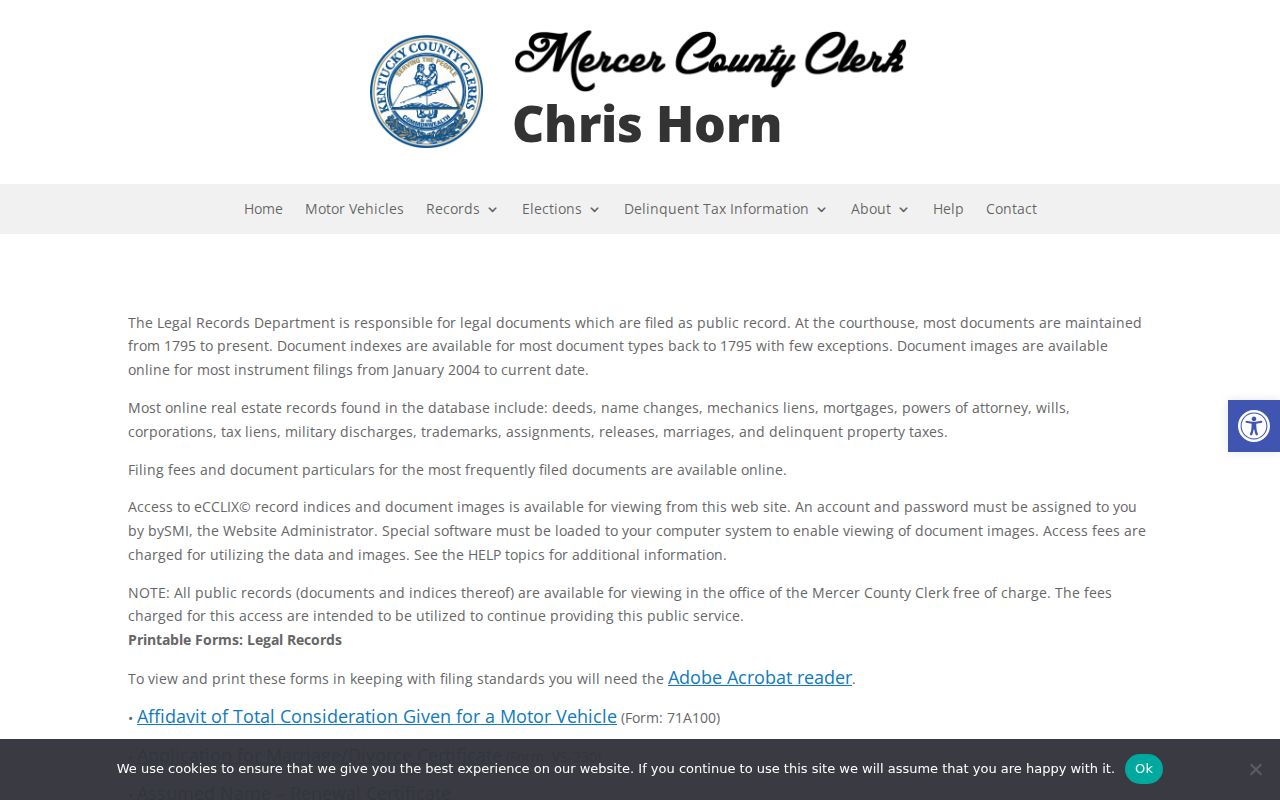
The county page anchors the modern online timeline. The archive sources cover the older path.
Search Mercer County Deed Records by Party
The clerk's index is built around parties. Start with a grantee on a known transfer, or with the owner shown on a dated PVA record. Search name variants, initials, trusts, and full company names. When a deed cites an earlier book and page, pull that instrument before trusting a broad name search.
| Search item | Purpose | Save from the result |
|---|---|---|
| Grantor name | Find a transfer out | Grantee, date, deed reference |
| Grantee name | Find an acquisition | Grantor, date, deed reference |
| Instrument class | Separate deeds from liens or releases | Exact indexed document type |
| Book/page or instrument number | Retrieve the recorded image | Complete locator and recording date |
Keep the parcel address and legal description at hand during any party search. Two parties can share a name, and one owner can hold several tracts.
Following a Mercer County Grantor-Grantee Chain
A chain of title is the ordered sequence of conveyances for one piece of land. Start with the newest deed. Work backward through prior-deed citations or the grantor's own acquisition. Test every link against the legal description. A matching name proves little once a parcel has split or merged.
- Copy the newest deed's recording date and instrument number or book/page.
- Read any “same property conveyed by” citation and retrieve that deed.
- If no citation appears, search the current grantor as a grantee in an earlier period.
- Compare lot, block, plat, acreage, calls, and exceptions before accepting the link.
- Branch for joint owners, estates, trusts, LLCs, corrections, and re-recordings.
- Grantor
- The party whose interest is transferred.
- Grantee
- The party receiving the stated interest.
- Chain of title
- The linked series of instruments affecting the same land.
- Record reference
- The book/page or instrument number used to retrieve a filing.
Read the Mercer Deed Beyond Its Names
The legal description is what preserves parcel continuity. Note the subdivision and lot, acreage, metes-and-bounds calls, easements, restrictions, plat references, and any cited prior deed. Plat references matter here. So do prior deed citations. A correction or re-recording can fix part of the description while the parties stay the same. A trustee or estate deed calls for close attention. The capacity stated in the instrument decides what it means.
| Identity | Grantor, grantee, marital or representative capacity |
|---|---|
| Locator | Recording date and instrument number or book/page |
| Land match | Legal description, subdivision, lot, acreage, prior deed |
| Related interests | Easements, restrictions, mortgages, releases, liens, plats |
A recording fee or tax assessment is never the sale price. Read the consideration language and any related affidavit. Do not turn a filing charge into transaction evidence.
Parcel splits and subdivision work make that description check vital. Match the deed to any cited plat, parent tract, lot number, road dedication, and easement. Planning news or a preliminary plan can suggest a name. But only the final recorded plat shows the instrument that entered the land records. If a phase name changes before filing, chase the parent deed, the developer entity, the surveyor, and street names as separate leads.
Separate execution from recording, too. A deed can be signed on one date and recorded much later. The January 1 PVA snapshot may still show the former owner for that tax year. Label both dates, then compare the latest grantee with the dated tax-roll owner. The gap can be ordinary timing. Do not call it an error without confirmation from the clerk and the PVA.
Mortgages, Releases, and Mercer's DOC ALERT
A deed review often reaches beyond deeds. Mortgages, assignments, releases, liens, lis pendens, restrictions, and easements belong in the picture. Powers of attorney and correction deeds belong there too. An unreleased mortgage entry may simply concern a paid loan. The release may not have appeared yet. The filing and the later record matter more than the index label.
The clerk offers free DOC ALERT emails for a chosen person or business name. A deed or mortgage filing under that name triggers an alert. An alert is a prompt to retrieve the instrument, not proof of fraud. Review the official DOC ALERT service. Use the exact recording reference if an unexpected notice arrives.
For a company name, compare the deed's exact entity wording. Check it against the Kentucky Secretary of State filing. Search punctuation, assumed names, registered names, and predecessor entities. A registered agent or officer is only a connection lead. That is not proof the person owns company land. The recorded grantee and the legal description remain the relevant evidence.
Mercer County Deed Fees Are Not Property Values
Mercer County's minimum recording fees are simple enough to list. A deed, real estate contract, easement, plat, or power of attorney costs $50 to record. A mortgage runs $80. Many releases, assignments, liens, restrictions, and correction deeds fall at $46. Certain marked instruments add per-page charges once a stated page threshold is passed. A longer document costs more than a short one. Always reconfirm the current fee table with the Mercer County clerk before filing anything.
None of these numbers tells you what the property is worth. They only budget the recording transaction itself. No consideration, taxable value, or fair cash value appears in a fee schedule. A family transfer, an exempt deed, a nominal-consideration sale, or a correction can all create a Mercer County deed record. None of them establishes any open-market price. Treat the fee as a filing cost. Never treat it as evidence of value in the property records.
Obtaining a Mercer County Deed Copy
Two routes exist for a Mercer County deed copy. eCCLIX is the paid, account-based option. It offers both index data and available images. Free public inspection happens at the Legal Records Department, 207 W Lexington Street in Harrodsburg. Hours are Monday through Friday from 8:00 a.m. to 4:30 p.m. Bring the party names, an estimated year, and the deed type. Include any record reference you already know. Staff can work with even partial information.
Written requests follow the clerk's open-records policy. You may deliver by hand, mail, fax, or email. The office makes its response determination within five working days. Ordinary forms needing original signatures are different. Those must be mailed or brought in person. Say clearly whether you want a plain inspection image or a certified copy. The two serve different purposes in property records work.
Recorded, not guaranteed. Mercer County deed records show filed instruments. They do not guarantee clear title, resolve an easement, or account for every unrecorded interest.
When Mercer County Deeds Lead to Archives
When a Mercer County deed chain reaches the older coverage line, move from the clerk index to KDLA or FamilySearch on purpose rather than by habit. Record the archive, series, book, page, film or image number for every step. Note whether you actually inspected the image itself. Handwritten indexes demand patience with spelling variants. Check adjacent pages too, because clerks often entered related entries out of order.
Local collections add depth. The Mercer Public Library History Research Center and the Harrodsburg Historical Society's Morgan Row library hold manuscripts, newspapers, obituaries, and government material. That material can explain names or development history. Still, the deed remains the controlling transfer record in every case. For a broad starting lookup, the Mercer County property search guide is the practical first stop.
Historical tax books, wills, and probate files often explain why a name enters or leaves a chain. That explanation is not a conveyance. Never insert such material as a transfer step unless an instrument supports it. Mark any archive catalog entry as a locator only when the page image went uninspected. The distinction matters most where a handwritten index leans on variants. It also matters where an estate produces several possible heirs.
A durable deed abstract earns its keep later. Put each recording date, grantor, grantee, deed class, record reference, legal-description match, and prior citation on its own line. Add notes for split parcels, combined parcels, corrected descriptions, or missing releases. A clerk, attorney, surveyor, or later researcher can then test the chain. They will not rely on a portal screenshot whose interface may change.
Some questions outlast the paper trail. Where title, boundary, foreclosure, probate, or easement issues stay unresolved, present the documents and the gaps plainly. Stop short of a legal conclusion. Ask the clerk for a missing locator or image. Bring the rest to a qualified Kentucky professional for an opinion. The record trail can be precise even when it does not support a final title determination.