
Trace Mercer County Former Owners
Mercer County offers layered access to its ownership trail. The clerk indexes most document types from 1795 forward. Online images begin in January 2004. For earlier former owners, the Kentucky Department for Libraries and Archives holds deed microfilm covering 1786 through 2009. FamilySearch catalogs grantor and grantee indexes from 1786 through 1908, plus deeds from 1786 through 1865.
| Transfer date | Grantor to grantee | Deed type | Book/page |
|---|---|---|---|
| Newest recorded date | Prior owner to current grantee | As indexed | Current deed reference |
| Prior recorded date | Earlier owner to that grantor | As indexed | Prior deed reference |
| Earlier recorded date | Earlier grantor to grantee | As indexed | Older book/page |
| Archive date | Historical parties | Deed or related instrument | Film, image, book/page |
The Mercer Clerk legal-records page sets out current coverage.
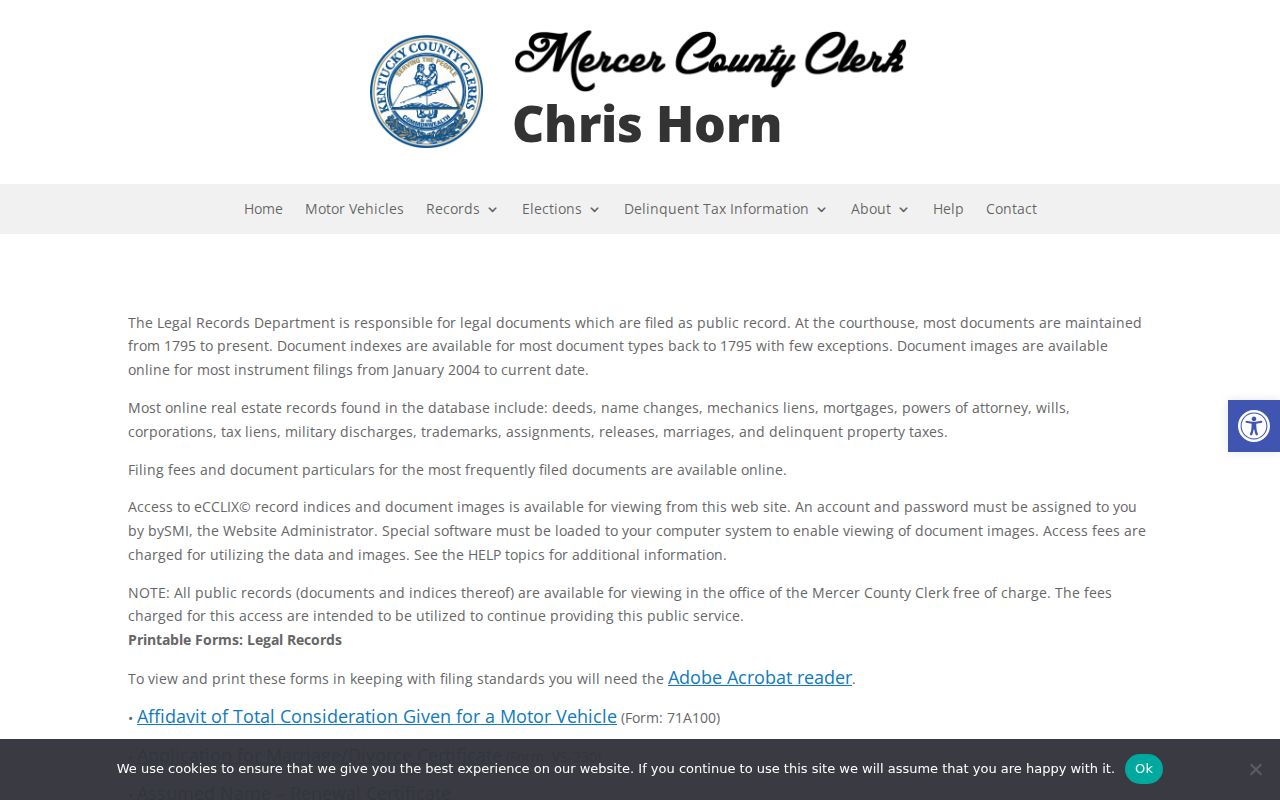
The clerk's page covers only the current layer. Earlier owners live in courthouse and archival records. A backward timeline works only with dates read from each deed image or index entry itself, never dates guessed from a catalog listing. Keep every former owner in sequence, grantor to grantee. Note the legal description and any cited prior deed beside each step, since one owner may have held several Mercer County tracts at once.
Walk Mercer County's Chain Backward
The latest recorded transfer names the first prior owner. Work in reverse through the Mercer County Clerk index, testing each name against the same land at every step.
- Find the newest deed and record the grantee, grantor, date, instrument number or book/page, and legal description.
- Treat that deed's grantor as the next former owner, then search the same name as a grantee in the earlier period.
- Follow any “same property conveyed by” clause or prior book/page citation before relying on a broad name search.
- Repeat while the description stays continuous. Branch for joint interests, estates, trusts, companies, corrections, splits, and combinations.
- At the online-image cutoff, continue through courthouse inspection, deed books, archival microfilm, or catalog access.
- Grantor
- The party conveying the interest described in a deed.
- Grantee
- The party receiving that interest.
- Chain of title
- The ordered set of transfers for the same land.
- Reverse index
- An index arranged to help locate instruments by the other side of a transaction.
- Warranty deed
- A deed carrying stated covenants; it is not interchangeable with a quitclaim deed.
- Quitclaim deed
- An instrument conveying whatever interest the grantor has, if any, without the same covenants.
Mercer Deeds Before Online Images
eCCLIX offers an account-based online route to Mercer County records. But most online images start in January 2004. Earlier former owners are not missing. The Harrodsburg office allows public inspection of its indexes and records. A specific existing record can also be requested through the clerk's open-records route. Include the book, page, party, and date. Indexed types reach back to 1795. Before that, shift deliberately to KDLA microfilm or the FamilySearch catalog. Record the series, film or image reference, any access restriction, and the actual spelling. And never treat a catalog description as the deed itself.
Coverage boundary. The current clerk index is stated from 1795, while archival Mercer deed material reaches 1786. Access varies by series and is not all free online.
Mercer County Names That Branch
A former owner may hide behind initials, a married surname, an executor title, or a trustee name. A company works too. Search every spelling. Try normalized forms and role terms too. The legal description is what separates two Mercer County residents who share a surname. Each instrument type carries its own meaning in the chain. An executor's deed points toward probate. A trustee's deed may cite its authority. A correction deed can repair a name while preserving the transfer. A mortgage or release never creates a new owner of record.
Track Mercer Parcel Changes
Today's Mercer County parcel may have begun as a farm tract, a subdivision lot, or a piece split off later. Plat maps tell that story. Compare PAMS_PIN, QCODE, the old unique ID, block, lot, map sheet, and legal description across the years. GIS fields support the match. They do not narrate history or name an owner. When an older deed covers more land than the current polygon, hunt down the plat, deed of dedication, easement, correction, and later conveyance. A mortgage may cover a larger parent tract. The backward chain should show which part moved, not merely repeat the street address.
Mercer Historical Search Variants
Older Burgin records reward place-name variants. The city's history points to Cane Run, Burgin Station, and the “Bergen” post-office spelling. Harrodsburg leads include subdivision names, former businesses, roads, and historic houses. Newspapers can help. So can local histories. Only a deed or plat proves ownership. The Mercer Public Library History Research Center and the Harrodsburg Historical Society hold local research material. KDLA lists county tax books and land records. A tax-book name should carry its year and never substitute for a recorded conveyance.
Mercer Estates and Prior Owners
Death breaks a clean seller-to-buyer line. So do probate, survivorship, and inherited interests. When an owner of record vanishes from the direct index path, search for personal representatives, affidavits of descent, wills, court cases, and later deeds. Keep restricted vital-record rules apart from public land records. An estate transfer may involve several heirs or a single personal representative acting under authority. Those roles are not the same. The deed image and probate file explain who held what. If an entity owned the Mercer County land, the Kentucky business search can reveal its filing history, but an officer becomes the former owner only when a deed says so.
Depth of Mercer Ownership Records
Mercer County ownership research rests on three different depths. The clerk's stated index reaches back to 1795. Archival and catalog leads point even earlier, toward 1786. The third depth is simply whatever deed image you actually inspect. No official statement of a courthouse fire or complete records loss exists, so treat the Mercer County property records as continuous rather than gapped. Handwritten indexes and shifting spellings mean adjacent-page and variant-name work pays off.
Former owners serve house history, estate research, purchase review, and title preparation. A research chain is not a title opinion. For one instrument copy, use the Mercer County deed records route; for today's tax-roll name, check the current owner record.
Lawful historical use. Trace prior owners for property research and preserve only needed facts. Never use the record trail to harass or target a living person.
Read Old Mercer Deeds in Layers
Read an old Mercer deed in layers. The index entry is only the first. It names the parties, the instrument type, the recording date, and a book/page or document number. The image adds a second layer: signatures, acknowledgment, consideration language, grantee address, and exhibits. The legal description forms the third, tying the transfer to metes and bounds, a subdivision lot, acreage, a survey, a parent deed, or a recorded plat. Exceptions matter too. They may reserve an easement, right-of-way, mineral interest, or life estate.
Watch the wording on consideration. A stated figure is not always a market sale price. A corrective deed can fix a name or legal description without adding another owner to the chain. An executor's deed may point toward probate. A trustee's deed may require the related authority. Record each deed record as written before deciding where it fits the former-owner timeline.
Mercer Tax Books as Context
KDLA's Mercer inventory holds historical tax materials alongside the deeds. A dated tax-book entry can place a person on land during a gap, test a spelling, or narrow the deed-book hunt. But it is assessment evidence for that year. It is not a conveyance. Mark it as a tax source and keep hunting the deed that moved the interest.
Tax names can also trail a transfer, just as today's January 1 roll sometimes does. Compare the tax year, the deed execution date, the recording date, and the legal description. That discipline keeps a prior tax owner from being slipped in after a newer recorded grantee merely because the tax volume was easier to find. Parcel details in the tax bill and the deed should agree.
Note: Preserve every unresolved link as a dated research gap until the underlying Mercer deed image can be inspected.